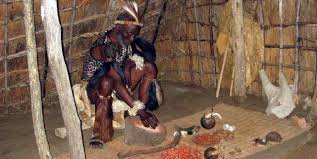
First, it is important to remember that while there are similarities between
African religions, there are also differences. Just as there are differences
in religious practice in the United States-not just between Christians, Moslems,
Jews, Hindus, and others, but even within Christianity (Roman Catholics and
many Protestant groups), Islam (Sunni, Sh'ite, Nation of Islam) and Judaism
(Orthodox, Conservative, Reform)-so too there are differences in religious
belief and practice among African religions
Secondly, although the supernatural-God and spirit world-are important in
African religions (as you will learn in the next section), religious belief
and practice are central to all aspects of life in Africa. That is, religious
beliefs impact the way people live their everyday lives, from what they eat
(or cannot eat), the way they farm, do everyday chores, hunt, make tools
and clothes, arrange themselves in families, marry, divide work among family
members, educate their children, treat illness, and bury the dead. Among
indigenous African religions, religious belief and practice are not restricted
to one holy day each week, be it Friday, Saturday, or Sunday, but are present
in the most common daily activities as well as in special ritual ceremonies.
African religions provide people with what some scholars call a world-view.
A world-view can be thought of as a system of values, attitudes,
and beliefs, which provide people with a mechanism to understand the world
in which they live and everyday events and occurrences. Maybe we can think
of a world-view as being like a language. Can you imagine how hard it would
be explain or understand everyday events and occurrences if we did not have
language-words? Words are essential tools that help us explain and understand
events and occurrences. But words come with their own meanings, we cannot
simply change the meanings of words when we use them to explain or to understand
events or why we live the way we do. Words and their meanings help shape
the way we see, and therefore how we explain, events. Similarly, the world-view
(values, attitudes, beliefs) that an individual learns from the time s/he
is a baby provides a mechanism that influences how s/he understands all that
happens to her/him, her/his community and the world in which s/he lives.
African indigenous religions provide a system of morality that establishes
right from wrong, good and appropriate from bad or inappropriate behavior.
Just as with Islam, Judaism, and Christianity, children growing up in African
religions learn right from wrong, and what is appropriate and inappropriate
behavior in every situation that they face.
like all world religions, rituals are important to African indigenous
religions. Rituals are cultural or religious ceremonies that celebrate or
commemorate specific events that have deep religious significance. Rituals
serve to reinforce important religious beliefs through meaningful activities
that bring comfort or joy and thus strengthen the unity of the followers
of the religious tradition. Rituals are often associated with important human
events: birth, marriage, death, planting, and harvest.
The Supernatural in Indigenous African Religions
Scholars who study religion in Africa tell us that all African societies
have a belief in God. Some African religions believe in one supreme God
who created the world and all that is in the world. Other African religions
believe that there is more than one God; however even in these religions,
usually one of the Gods is claimed to be the supreme God who was responsible
for creating the world. Since there are many different language groups
in Africa, there are many different names for God.
Whether or not a particular African religion believes in one or several
Gods, the way God is viewed in most African religions is both similar and
different than the way the monotheistic religions
characterize God. Judaism, Islam, and Christianity are the main monotheistic
religions. These religions teach that there is only one God and that that
God not only created the universe, God has complete control over that universe.
Moreover throughout history, the one supreme God communicates directly
with humans, and God is directly involved in the lives of humans.
many African religions share the following concept of God. These concepts
are quite similar to the way God is viewed in Christianity, Islam, and
Judaism, the three main monotheistic religions.
God is creator of all things.
God sustains creation
God provides for and protects creation
God rules over the universe
God is all powerful (omnipotent)
God is all-knowing (omniscient-knows everything that happens in
the world)
God is viewed as parent (sometimes as a father and sometimes as a mother)
God supports justice
Human-beings cannot directly know God.
Given these similarities it should not be surprising that Africans from
all over the continent often accepted the introduction of Islam and Christianity
into their communities.
In spite of these similarities there are important differences in the
way God and the supernatural are viewed in African religions in comparison
to Islam, Judaism, and Christianity. In most African religious systems,
God (or the Gods) after creation was not directly involved in the human
society or the individual lives of people. Remember how in the creation
stories the Gods were engaged in the creation of people, but after creation,
the Gods usually withdrew from direct contact with human-beings?
The idea of an isolated God does not make the supernatural un-important
in Africa religions. Indeed, the supernatural, or spiritual realm, is most
important to African religious belief. Between an all-powerful God and
humans is a pantheon of spirits. These spirits are directly engaged in
the lives of human beings, and can act as intermediaries between God and
humans.
Spirits in African religious traditions share some of the same characteristics
of angels in the Christian, Islamic, and Jewish traditions. Good spirits
help to protect against illness and misfortune and assist humans by providing
rain needed for crops, as well as, fish and game animals used for food.
However, not all spirits are good, some spirits are viewed as evil and
are believed to be responsible for illness, premature death, and other
forms of suffering and misfortune.
We can all agree, the world is in disarray. The planet is out of order
with a lagging economic crisis, terror mayhem, police brutality, a
frightening Ebola outbreak, suspicious Malaysian flight’s mischief,
religious wars etc. Yes, our world is in peril. All we can do is ask
why? Common sense tells us there is a reason for every action. To every
effect there is a cause. So, the best we can do is to try and answer the
– why. Right now, the conspiracy theorists have a huge pile of
controversies to dissect. This is why, in this blog, I will not answer
the why, what I will do is help you put the question in a clear
perspective. This way, it will be up to you to decide the answer to –
why.
Economic Crisis:
After a disgraceful, wallet shrinking recession, we are breathing a
little easier than we did when President Bush Jr. was in office.
Firstly, the national deficit is not tripling as it was. Second, the
labor market is much better than it was. Of course, these new jobs are
not high paying jobs, many are still underemployed or unemployed, but
you have to admit, at least the economy is not losing jobs in the
hundreds of thousands every month, as it did before the Obama
administration which hasn’t been awesome but alright.
American families do not leave the
keys in their homes and flee to the valley as they were in 2009 and if
Wall Street is still giving fat bonuses you and I will never know
because it is not in the news anymore. At this point, it’s safe to say
the recession is over. GM is not laying off or closing plants and the
price of gas has not reached $10 a gallon. However, people in the middle
class are still gnashing their teeth. People are still out. The bill of
health care is still high, there is no job security and to be honest,
there are millions out there who are still flat broke. Some say the
recession is still here. Why?
Terror Indignation:
Tell me you did not laugh when you heard there was a new terrorist
group that has made Al Qaeda look like Girl Scouts. Well, you did not
laugh because you wished there wasn’t a more difficult terrorist group
out there, you did because you could not imagine an organization so vile
that even Al Qaeda denounced them. The joke soon ended when we heard
how serious these guys are. They copied their strategy of the West by
using the media, social networking and advanced systems of public
relations to increase their visibility. And it appears they came out of
nowhere.
Before long, we heard they were not
only willing to recruit Westerners but in fact, Westerners are willing
to flock to their battlefields. Really? You mean guys are willing to
give up their SUVs, townhouses and so called freedoms of the West to
live, fight and die in some of the harshest terrines of the Middle East?
Why? What have we done to make them even consider joining the enemy to
fight against their own countries? This problem is so wild the West has
put in place, measures to ensure that the youths can not be recruited
into “terror” and if they were, they would struggle to return home to
conduct attacks on the homeland. What is making them want to do that?
Police Brutality:
Since the murder of Trayvon Martin, there have been several other police
murders of unarmed civilians in America. In all respects, this is yet
another challenge in our world today. In 2014, Americans have come to
realize that even as the government seeks to deprive citizens of their
rights to keep and bear arms, the same government is arming the police
with military style weapons. In most cases, it is difficult to
differentiate between the police and the army since the police have
since copied the military by wearing their uniforms and deploying
military-style equipment and weapons against the unarmed citizens of
America.
The police are power crazed and
desperate to incite fear. They stop at nothing, not even the murder of
teenagers or young men or parents in the presence of their children. In
America, the police have declared war on all citizens. The National
Guard was deployed in Missouri this summer, but the government quickly
aborted the deployment knowing that an attempt to control the police
could lead to a fire fight with the National Guard, should they try to
stop them. Would the police really fire on the National Guard? Why?
Ebola Outbreak:
This same year, as if all the current troubles are not serious enough,
there is the worst outbreak of Ebola in history. If you ask the
Africans, they will tell you that they are well aware that the virus was
released into West Africa, that under no circumstances was it an
accident. The disease spread quickly because the first victims were
convinced that they had been infected with the virus deliberately so,
they fled treatment centers where they suspected a more sinister agenda
took place. In the West, it is believed that the virus was ingested from
eating infected wild animals.
Just like the aids virus which
Africans are convinced was brought to Africa from the West to blame them
for its existence, West Africans now claim they ate bush meat for
centuries without ingesting any diseases. They are in disbelief how was
it possible to suddenly ingest Ebola in 2014 from the same bush meat
they had been eating all these generations? Shortly after the outbreak,
the second flight of Malaysia was shot from the sky. Conspiracy
theorists began to spread rumors on social networking sites that a
doctor was en-route to Australia to reveal the true source of the
outbreak when the flight was stopped from reaching Sydney.
Malaysia Flight:
This brings us to the mysterious downing of two flights from Malaysia
this year. The first one disappeared for hours before it was reported. A
large ocean research was launched with several speculations told to
analyze when, how or where the plane lost contact with air traffic
control or what happened on board and where it could have crashed. After
months of research and a very confused public dismay, we were reminded
that our super powers are significantly limited especially when it comes
to the ocean.
Ultimately the media have moved on
to other stories and the audience is left to ask, why? As if the
families from the first flight had not suffered enough, we heard of a
Russian involvement in Ukraine that led to unrest in the region. During
this agitation a second flight from Malaysia was blown out of the sky.
The remains of the crew, passengers, goods and the plane were left
unattended in a rebel held Ukrainian wilderness. No one has been held
accountable, no explanation has been given, details of the incident are
scarce and the world has done nothing. Why?
Many people seek marriage but many
do not know what marriage really is. Most men simply want to lock down
that special girl to keep her from slipping away and most women are
simply eager to have that big day. This is not to say they are not in
love but some guys actually think they’ll never find someone who would
STAY with them? So when one comes along that seems to be continuously
interested, the guy drops on his knees and pops the question. Many do
not check for compatibility; if the woman he’s about to marry has the
makings of a loyal wife or if he’s a wannabe Hollywood prince.
The woman may not care to know what
the man really expects from her. As long as she gets a dream wedding
and a huge ring she’s happy. The man may not even know what the original
construct of marriage is. Many people were not brought up to know that
marriage is not just about the wedding day. The guy may not understand
his responsibility to her. All he knows, he wanted a beautiful crush to
fall in his arms so he married the one that came along. He never
expresses his true feelings because he is afraid she might turn on him.
The essence of family is fragile from the very beginning due to the
absence of fundamental truths.
For most, marriage is a fantasy.
This means it is more of a built in mentality of what a husband should
be. How he should act, how he should be with other women, what kinds of
job he should have; anticipating a home and a family which she’s
fantasized. Not once does the guy stop to ask will she be the same after
she has children? Will she maintain the seduction? Will she honor his
wishes? Will he follow her lead and trust in her judgment? To him,
simply being with a beautiful woman is enough. And many women feel
victimized in their traditional role so they seek role reversal. While
she focuses on a wedding showoff with family and friends he can’t see
beyond sex, money and control.
The problem is, most of the ideas
of a perfect husband comes from revised new age relationship schemes
shown in movies, TV Shows, magazines or friends but the idea of a
perfect wife comes from the traditional construct of marriage. No one
told her that for her, marriage is a life where her goal is to prolong
the survival of his genes. As wonderful as the big day sounds for most
marriage hopefuls many women do not even know why they should take their
husband’s last name? This man who she is about to say “I do” to; will
she obey him knowing he is the ordained head of her family, above the
children or the pets even? No. She’s new school while he’s old school.
The whole thing is an explosion waiting to happen.
The mistake most couples make today
is they never separate reality from fantasy. Many are not prepared for
the turmoils of a relationship. One big argument and out they go!
Getting married is a GOOD thing if it’s with the right person. But there
are a few mistakes that could hinder a marriage. Baby mama drama with
your partner’s ex, someone who blew their credit before they met you,
criminal record, misrepresentation or even worst, bad karma. Now you
can’t afford a proper home because of your partner’s credit, one of you
cannot find a decent job. Unexplained health issues? Disagreement on
what to spend money on etc. And as much as I respect the court system I
strongly believe man made laws are not suitable to govern these issues.
Marriage should not be settled in
court being that it is a spiritual pact between two people. It should
involve a Priest, an Imam or a Rabbi… not a judge. Young people need to
be taught this. Just think about it, the law outlawed polygamy and
legalized homosexuality later. Who is to say which one is wrong or
right? Women have become independent. Does this means more alimony and
child support payments will go to men? Courts can decide who you love
and who gets rewarded or punished for a breakup? Instead, shouldn’t
people be taught their obligations within each relationship so they can
work it out with their spiritual adviser? But then again, some may say
the spiritual advisor also have explaining to do. In either case the
point I’m making is marriage is more complicated than it seems.*
Everyone seems to know what a man should DO. A good man should never
cheat, a good man should treat his woman with respect… good man this and
good men that. Is it that there are no husband material left out there?
The notion is all men are doing something wrong. So I ask you, are
woman doing everything right? If the answer is no then what are they
doing wrong? There are thousands of quotes about how a strong woman
should never need a man and what a woman should and should not accept.
But nothing seems to denote what a man should not tolerate. What’s wrong
here?
OK ladies, let’s have an honest
conversation. Don’t take this as an attack, rather, use it as an
awakening. How is your ability to find a husband? How come every man you
date already has a woman? Other women are happily married yet you can’t
find a husband? If he’s not married, he has a girlfriend. If he’s
single, the question of whether your potential relationship will end up
in marriage is typically out of your hands. Correct me if I’m wrong but
many women are giving up on love and settling to become single mothers.
If you have to settle what will you settle for? A man with some flaws or
being a single mother? Will you even settle? What can women do to fix
this problem? Is there any responsibility on the woman’s part?
Many women have given up “trying”
to find the right man but every week they turn down a potential husband.
I’m going to focus my attention on North America, Europe and Australia
since these are the main cultures that have deviated from the time
immemorial tradition of how a husband finds a wife or what a wife should
do or be like. These cultures also have the highest divorce rate as
well as the highest number of unmarried single women with children.
Yes, this article is all about you.
Ladies, we have already chastised the men for their shortcomings. In
fact, we have resorted to the conclusion that “good men do not exist” or
are very rare. So now it’s your turn to face the music. What is a good
woman? Are there many wife material? Is a wife hard to find? Again,
please do not take this as an attack. It is an attempt to address a
topic that people avoid. In a world of liberated women, it is worth
asking as men are, are women to be held accountable for their decisions
and actions or is it truly the man’s fault? Is he a husband waiting for a
wife to come by?
Take a look at the map below: The
pink area shows countries where there are more women than men and the
blue area shows countries where there are more men than women. Perhaps
we will arrived at some interesting conclusions. This blog is not about
women who are not looking, already have a man or are among those who can
get and keep an exclusive boyfriend or husband whenever she wants for
as long as she want. It is not about the lady who is not trying to find a
husband. This blog is for the hopeless romantic, sensual, somewhat
innocent woman who is ready and willing to do what it takes and has a
lot of love to offer a husband; who is also emotionally strong knowing
she deserves marriage and a family.
The lonely divorced, the
heartbroken, the lover, young or mature who knows that she possess the
skills to have and upkeep a HAPPY home. One without mental reservation
against her future husband. This is for the woman who steps to the plate
and take full responsibility for her decision and actions. But for one
reason or another she cannot find a husband. According to the map above,
women, no matter how cute, special or unique, seems to be in endless
supply. The law of supply states, the higher the supply, the lower the
price or the quantity demanded. If we were to apply this analogy to the
sex ratio, it will be necessary for every single woman to note why
husbands are far rarer to find than wives.
Ladies ask yourself; if you could
have the man of your dreams with you right now what would he be like?
Before I go further, I’d like to reiterate that this is not to cast
blame or judge you. It is an educative article that discusses the topic
of finding true love without mocking, agitating or belittling anyone.
The goal here is to give each other ideas as to what could be improved
in our behavior and perceptions or to take responsibility for our
actions. Yes I know, it’s not fair that he can have ten good women
whenever he wants when you can barely find one good man. It is important
to note that while you may throw him out for deserving better, the
chances of him finding another good woman are far greater than your
chances of replacing him with a better man. This is assuming of cores
that we both agree that domestic or psychological abuse are out of the
question.
There is a high ratio of women
compared to men in the world. You know you are beautiful, you feel sexy,
you are proudly independent. You don’t want to be used. You seem
sophisticated. You are a beautiful, smart and articulate woman. Yes, you
are special! But these are NOT all the factors that determines how men
choose a life mate? What makes you beautiful? It’s your outwards looks,
your smarts and your positive behavior towards the one you attract? You
can get 100 Likes and Comments on Facebook with one photo but that does
not mean you are wife material?
It’s your voice, your body
language, your style, your availability and your consciousness that
makes you “wifeable.” These are the important points to remember
especially if you get 100 phone numbers from different men but none of
those 100 men end up being the one. Is it the 100 men’s fault or did you
have a part to play? Say it’s men’s fault and hope to get lucky or
accept some responsibility and become proactive and find your husband.
The question becomes, if being smart, beautiful and unique is not enough
then what else do you have to do or be to pull in the one to spend the
rest of your life with? Responsible words and actions.
Ladies, let’s assume that love is
not the issue. Sparks fly, romance and sex only gets better. You love
him and he loves you. And yet life must be lived. Bills must be paid,
food must go on the table while the necessities of life are provided.
Back in the day it was the man’s responsibility to work and pay all the
bills and then provide food, protection and security for his woman and
children. In return the woman’s responsibility was to care for the home
and raise the children. Before that even, cavemen went out to hunt and
fend off hooligans while cave women stayed within the protection of the
cave. That was then. Today, we live in a digital age where physical
strength earns far less than technological know how.
Women are increasingly better at
working with technology which then makes them breadwinners. Women have
earned the right to be today’s hunters. Quite frankly women don’t even
have to wait around for a man to show up because she can simply run to
the grocery store and buy food. Women do not need men to protect them
because they can call 911. So naturally if she does not need him to hunt
for her or protect her from outlaws and bandits then why should she
have to clean, cook, raise children and be a stay at home mom? This
change in the equation of a family has altered the entire relationship
system which then has to be rearranged. The problem is LOVE did not
change. The way how one person loves another has remained the same as it
were.
Imagine having to work your whole
life to provide but instead of a thank you, you were told your efforts
are no longer needed. She can fend for herself, she does not have to
uphold anymore traditional obligations. Can you imagine the impact this
has on the family structure? That has to change as well. The children
respect and appreciate their mother more than their father for starters.
This is apoplectic since more men are unqualified for jobs while women
earn higher wages. Can the courts reverse alimony laws, reverse spousal
support since more men stay at home while their women earn more? This is
how complicated it is today.
Does this sound right with the
traditional mindset in general? No, it shows the need for double income
households. A man has to have something else to offer beside the usual
food, protection, cloth and shelter and women have to offer more than
cooking, cleaning and caring for babies. Give and take, some are still
traditional, preferring old customs while others are new age thinkers
who frown on old traditions. On the work site the woman becomes
accountable for her quality of work ever bearing in mind that being
female no longer exaggerates her. Some women are not ready for this.
Yes, he will always offer his
support but he is no longer obligated to be responsible. Her desire to
be relieved of traditional obligations also relieved him of his
responsibilities. Relationships are about love but to make it work there
has to be a negotiation. No matter how you spin it. One person
furnishes this, the other addresses that …and both parties are content
after receiving what the other had to offer. This is the foundation of a
mature relationship. Love is the cement that holds it in place.
When you add love in this mix
you’ll find that selfishness and greed or insecurities and distrust can
no longer exist. Set aside traditional customs, cultural difference and
baggage from past failed relationships. Now that women are capable of
going out and doing it on their own, a traditional man is free to
flounder away. Hence why the typical ‘good men’ are fading away. To have
good men and good women in a none traditional setting simply means the
definition of good should be revised to fit the requirements of this
age. However, this will not change the need for love or the need to pay
bills or provide the basic necessities of life.*
When tourists visit sub-Saharan Africa, they often wonder “Why there are no historical buildings or monuments?”
The reason is simple. Europeans destroyed
most of them. We only have a few drawings and descriptions by travelers
who visited the places before their destruction. In some places, ruins
are still visible. Many cities were abandoned when Europeans brought
exotic diseases (smallpox and influenza) which started spreading and
killing people. Most of those cities lie hidden. In fact the biggest
part of Africa history is still under the ground.
(Please note – the research supporting this post is mostly derived from Robin Walker, a distinguished panafricanist and historian who has written the book ‘When We Ruled’, and by PD Lawton, another
great panafricanist, who has an upcoming book titled “The Invisible
Empire”. All quotes and excerpts below are from the books of Robin
Walker and PD Lawton. I highly recommend you to read Walker’s book ‘When We Ruled’ to
get a full account of the beauty of the continent before its
destruction. You can get more info about PD Lawton work by visiting her
blog: AfricanAgenda.net. Robin Walter and PD Lawton have quoted quite heavily another great panafricanist Walter Rodney who wrote the book ‘How Europe Underdeveloped Africa‘. Additional information came from YouTube channel ‘dogons2k12 : African Historical Ruins’, and The Ta Neter Foundation work. Most drawings are from the book African Cities and Towns Before the European Conquest by Richard W. Hull,
published in 1976. That book alone dispels the stereotypical view of
Africans living in simple, primitive, look-alike agglomerations,
scattered without any appreciation for planning and design.)
We begin with Benin City. At the end of the
13th century, a European traveler encountered the great metropolis in
West Africa (present Nigeria, Edo State), writing:
“The town seems to be very great. When you
enter into it, you go into a great broad street, not paved, which seems
to be seven or eight times broader than the Warmoes street in
Amsterdam…The Kings palace is a collection of buildings which occupy as
much space as the town of Harlem, and which is enclosed with walls.
There are numerous apartments for the Prince`s ministers and fine
galleries, most of which are as big as those on the Exchange at
Amsterdam. They are supported by wooden pillars encased with copper,
where their victories are depicted, and which are carefully kept very
clean. The town is composed of thirty main streets, very straight and
120 feet wide, apart from an infinity of small intersecting streets. The
houses are close to one another, arranged in good order. These people
are in no way inferior to the Dutch as regards cleanliness; they wash
and scrub their houses so well that they are polished and shining like a
looking glass.” (Source: Walter Rodney, ‘How Europe Underdeveloped Africa, pg. 69)
The mediaeval Nigerian city of Benin was built to “a scale comparable
with the Great Wall of China”. There was a vast system of defensive
walling totalling 10,000 miles in all. Even before the full extent of
the city walling had become apparent the Guinness Book of Records
carried an entry in the 1974 edition that described the city as: “The largest earthworks in the world carried out prior to the mechanical era.” – Excerpt from “The Invisible Empire”, PD Lawton, Source-YouTube, uploader-dogons2k12 `African Historical Ruins`
“Benin art of the Middle Ages was of the highest quality. An official
of the Berlin Museum für Völkerkunde once stated that: “These works
from Benin are equal to the very finest examples of European casting
technique. Benvenuto Cellini could not have cast them better, nor could
anyone else before or after him . . . Technically, these bronzes
represent the very highest possible achievement.”
Sadly, in 1897, Benin City was destroyed by British forces under Admiral Harry Rawson. The city was looted, blown up and burnt to the ground. A collection of the famous Benin Bronzes are now in the British Museum in London. Part of the 700 stolen bronzes by the British troops were sold back to Nigeria in 1972.
Here is another account of the great Benin
City regarding the city walls “They extend for some 16 000 kilometres in
all, in a mosaic of more than 500 interconnected settlement boundaries.
They cover 6500 square kilometres and were all dug by the Edo people.
In all, they are four times longer than the Great Wall of China, and
consumed a hundred times more material than the Great Pyramid of Cheops.
They took an estimated 150 million hours of digging to construct, and
are perhaps the largest single archaeological phenomenon on the planet.”
Source: Wikipedia, Architecture of Africa.” Fred Pearce the New
Scientist 11/09/99.
Here is a view of Benin city in 1891 before the British conquest. H. Ling Roth, Great Benin, Barnes and Noble reprint. 1968.
Did you know that in the 14th century the city of Timbuktu in West Africa was five times bigger than the city of London, and was the richest city in the world?
Today, Timbuktu is 236 times smaller than
London. It has little to show of a modern city. Its population is two
times less than 5 centuries ago, impoverished with beggars and dirty
street sellers. The town itself is incapable of conserving its past
ruined monuments and archives.
Back in the 14 century, the 3 richest places
on earth was China, Iran/Irak, and the Mali empire in West Africa. From
all 3 the only one which was still independent and prosperous was the
Mali Empire. Eventually China and the whole of the Middle East were
conquered by Genghis Kan Mongol
troops which ravaged, pillaged, and raped the places. The Mali empire
lived on under the rule of the richest man ever in the history of
humanity, Mansa Musa, emperor of the 14th century Mali Empire which covered modern day Mali, Senegal, Gambia, and Guinea.
At the time of his death in 1331, Mansa Musa
was worth the equivalent of 400 billion dollars. At that time Mali
Empire was producing more than half the world’s supply of salt and gold.
Here below are some depictions of emperor Mansa Musa.
When Mansa Musa went on a pilgrimage to Mecca
in 1324, he carried so much gold, and spent them so lavishly that the
price of gold fell for ten years. 60 000 people accompanied him.
He founded the library of Timbuktu, and the famous manuscripts of Timbuktu which cover all areas of world knowledge were written during his reign.
Witnesses of the greatness of the Mali empire
came from all part of the world. “Sergio Domian, an Italian art and
architecture scholar, wrote the following about this period: ‘Thus was
laid the foundation of an urban civilisation. At the height of its
power, Mali had at least 400 cities, and the interior of the Niger Delta
was very densely populated.’
The Malian city of Timbuktu had a 14th century population of 115,000 – 5 times larger than mediaeval London.
National Geographic recently described
Timbuktu as the Paris of the mediaeval world, on account of its
intellectual culture. According to Professor Henry Louis Gates, 25,000
university students studied there.
“Many old West African families have private
library collections that go back hundreds of years. The Mauritanian
cities of Chinguetti and Oudane have a total of 3,450 hand written
mediaeval books. There may be another 6,000 books still surviving in the
other city of Walata. Some date back to the 8th century AD. There are
11,000 books in private collections in Niger.
In Timbuktu today, there are about 700,000
surviving books. They are written in Mande, Suqi, Fulani, Timbuctu, and
Sudani. The contents of the manuscripts include math, medicine, poetry,
law and astronomy. The world’s first encyclopedia was created in Mali in
the 14th century, eons before the Europeans got the idea 4 centuries
later.
A collection of one thousand six hundred
books was considered a small library for a West African scholar of the
16th century. Professor Ahmed Baba of Timbuktu is recorded as saying
that he had the smallest library of any of his friends – he had only
1600 volumes.
Concerning these old manuscripts, actor
Michael Palin, in his TV series ‘Sahara’, said the imam of Timbuktu “has
a collection of scientific texts that clearly show the planets circling
the sun. They date back hundreds of years . . . Its convincing evidence
that the scholars of Timbuktu knew a lot more than their counterparts
in Europe. In the fifteenth century in Timbuktu the mathematicians knew
about the rotation of the planets, knew about the details of the
eclipse, they knew things which we had to wait for 150 almost 200 years
to know in Europe when Galileo and Copernicus came up with these same
calculations and were given a very hard time for it.”
The old Malian capital of Niani had a 14th
century building called the Hall of Audience. It was an surmounted by a
dome, adorned with arabesques of striking colours. The windows of an
upper floor were plated with wood and framed in silver; those of a lower
floor were plated with wood, framed in gold.
Malian sailors got to America in 1311 AD, 181
years before Columbus. An Egyptian scholar, Ibn Fadl Al-Umari,
published on this sometime around 1342. In the tenth chapter of his
book, there is an account of two large maritime voyages ordered by the
predecessor of Mansa Musa, a king who inherited the Malian throne in
1312. This mariner king is not named by Al-Umari, but modern writers
identify him as Mansa Abubakari II.” Excerpt from Robin Walker’s book, ‘WHEN WE RULED’
Those event were happening at the same period
when Europe as a continent was plunged into the Dark Age, ravaged by
plague and famine, its people killing one another for religious and
ethnic reasons.
Here below are some depiction of the city of Timbuktu in the 19th century.
“Kumasi was the capital of the Asante Kingdom,
10th century-20th century. Drawings of life in Kumasi show homes, often
of 2 stories, square buildings with thatched roofs, with family
compounds arranged around a courtyard. The Manhyia Palace complex drawn in another sketch was similar to a Norman castle, only more elegant in its architecture.
“These 2 story thatched homes of the Ashanti
Kingdom were timber framed and the walls were of lath and plaster
construction. A tree always stood in the courtyard which was the central
point of a family compound. The Tree of Life was the altar for family
offerings to God, Nyame. A brass pan sat in the branches of the tree
into which offerings were placed. This was the same in every courtyard
of every household, temple and palace. The King`s representatives,
officials, worked in open-sided buildings. The purpose being that
everyone was welcome to see what they were up to.
“The townhouses of Kumase had upstairs
toilets in 1817.This city in the 1800s is documented in drawings and
photographs. Promenades and public squares, cosmopolitan lives,
exquisite architecture and everywhere spotless and ordered, a wealth of
architecture, history, prosperity and extremely modern living” – PD
Lawton, AfricanAgenda.net
Winwood Reade described his visit to the
Ashanti Royal Palace of Kumasi in 1874: “We went to the king’s palace,
which consists of many courtyards, each surrounded with alcoves and
verandahs, and having two gates or doors, so that each yard was a
thoroughfare . . . But the part of the palace fronting the street was a
stone house, Moorish in its style . . . with a flat roof and a parapet,
and suites of apartments on the first floor. It was built by Fanti
masons many years ago. The rooms upstairs remind me of Wardour Street.
Each was a perfect Old Curiosity Shop. Books in many languages, Bohemian
glass, clocks, silver plate, old furniture, Persian rugs, Kidderminster
carpets, pictures and engravings, numberless chests and coffers. A
sword bearing the inscription From Queen Victoria to the King of
Ashantee. A copy of the Times, 17 October 1843. With these were many
specimens of Moorish and Ashanti handicraft.” – Robin Walter
The beautiful city of Kumasi was blown up, destroyed by fire, and looted by the British at the end of the 19th century.
Here below are few depictions of the city.
In 1331, Ibn Battouta, described the Tanzanian city of Kilwa,
of the Zanj, Swahili speaking people, as follows ” one of the most
beautiful and well-constructed cities in the world, the whole of it is
elegantly built”. The ruins are complete with `gothic` arches and
intricate stonework, examples of exquisite architecture. Kilwa dates
back to the 9th century and was at its peak in the 13th and 14th
centuries. This international African port minted its own currency in
the 11th -14th centuries. Remains of artefacts link it to Spain, China,
Arabia and India. The inhabitants, architects and founders of this city
were not Arabs and the only influence the Europeans had in the form of
the Portuguese was to mark the start of decline, most likely through
smallpox and influenza.” – Source: UNESCO World Heritage Centre, excerpt
from “The Invisible Empire” byPD Lawton
In 1505 Portuguese forces destroyed and burned down the Swahili cities of Kilwa and Mombasa.
The picture below shows an artist’s
reconstruction of the sultan’s palace in Kilwa in the 1400’s, followed
by other ruins photographs.
“A Moorish nobleman who lived in Spain by the name of Al-Bakri questioned
merchants who visited the Ghana Empire in the 11th century and wrote
this about the king: “He sits in audience or to hear grievances against
officials in a domed pavilion around which stand ten horses covered with
gold-embroidered materials. Behind the king stand ten pages holding
shields and swords decorated with gold, and on his right are the sons of
the kings of his country wearing splendid garments and their hair
plaited with gold. The governor of the city sits on the ground before
the king and around him are ministers seated likewise. At the door of
the pavilion are dogs of excellent pedigree that hardly ever leave the
place where the king is, guarding him. Around their necks they wear
collars of gold and silver studded with a number of balls of the same
metals.” - http://en.wikipedia.org/wiki/Ghana_Empire#Government – the source of the quote is given on wikipedia as p.80 of Corpus of Early Arabic Sources for West Africa by Nehemia Levtzion and John F.P. Hopkins)
Here below are few depictions of Ghana Empire.
In 15th when the Portuguese, the first
Europeans to sail the Atlantic coasts of Africa “arrived in the coast of
Guinea and landed at Vaida in West Africa, the captains were astonished
to find streets well laid out, bordered on either side for several
leagues by two rows of trees, for days they travelled through a country
of magnificent fields, inhabited by men clad in richly coloured garments
of their own weaving! Further south in the Kingdom of the Kongo(sic), a
swarming crowd dressed in fine silks’ and velvet; great states well
ordered, down to the most minute detail; powerful rulers, flourishing
industries-civilised to the marrow of their bones. And the condition of
the countries of the eastern coast-mozambique, for example-was quite the
same.”
Another example is the Kingdom of Congo in
the 15th Century was the epitome of political organization. It “was a
flourishing state in the 15th century. It was situated in the region of
Northern Angola and West Kongo. Its population was conservatively
estimated at 2 or 3 million people. The country was fivided into 6
administrative provinces and a number of dependancies. The provinces
were Mbamba, Mbata, Mpangu, Mpemba, Nsundi, and Soyo. The dependancies
included Matari, Wamdo, Wembo and the province of Mbundu. All in turn
were subject to the authority of The Mani Kongo (King). The capital of
the country(Mbanza Kongo), was in the Mpemba province. From the province
of Mbamba, the military stronghold. It was possible to put 400,000 in
the field.” – Excerpt from “The Invisible Empire” by PD Lawton
Below is an depiction by Olfert Dapper,
a Dutch physician and writer, of the 17th century city of Loango
(present Congo/Angola) based on descriptions of the place by those who
had actually seen it.
Depiction of the City of Mbanza in the Kongo Kingdom
King of Kongo Receiving Dutch Ambassadors, 1642 DO Dapper, Description de lAfrique Traduite du Flamand (1686)
Portuguese Emissaries Received by the
King of Kongo, late 16th cent Duarte Lopes, Regnum Congo hoc est
warhaffte und eigentliche , Congo in Africa (Franckfort am Mayn, 1609)
Until the end of 16 century, Africa was far
more advanced than Europe in term of political organization, science,
technology, culture. That prosperity continued, despite the European
slavery ravages, till the 17th and 18th century.
The continent was crowded with tens of great
and prosperous cities, empires and kingdoms with King Askia Toure of
Songhay, King Behanzin Hossu Bowelle of Benin, Emperor Menelik of
Ethiopia, King Shaka ka Sezangakhona of South Africa, Queen Nzinga of
Angola, Queen Yaa Asantewaa of Ghana, Queen Amina of Nigeria.
We are talking here about Empires, Kingdoms, Queendoms, Kings, emperors, the richest man in the history of humanity in Africa.
Were these Kings and Queens sleeping on banana trees in the bushes? Were they dressed with tree leaves, with no shoes?
If they were not sleeping in trees, covered with leaves, where are the remainder of their palaces, their art work?
In the mid-nineteenth century, William
Clarke, an English visitor to Nigeria, remarked that: “As good an
article of cloth can be woven by the Yoruba weavers as by any people . .
. in durability, their cloths far excel the prints and home-spuns of
Manchester.”
The recently discovered 9th century Nigerian
city of Eredo was found to be surrounded by a wall that was 100 miles
long and seventy feet high in places. The internal area was a staggering
400 square miles.” Robin Walter
Loango City in the Congo/Angola area is
depicted in another drawing from the mid 1600`s. Yet again, a vast
planned city of linear layout, stretching across several miles and
entirely surrounded by city walls, bustling with trade. The king`s
complex alone was a mile and a half enclosure with courtyards and
gardens. The people of Loango had used maths not just for arithmetic
purposes but for astrological calculations. They used advanced maths,
linear algebra. The Ishango Bone from the Congo is a calculator that is
25 000 years old. “The so-called Ishango bone`s inscriptions consist of
two columns of odd numbers that add up to 60,with the left column
containing prime numbers between 10 and 20, and the right column
containing both added and subtracted numbers.” Source: Ta Neter Foundation. It is on view in a museum in Belgium. – Excerpt from “The Invisible Empire” by PD Lawton
The beautiful city of Loango was destroyed by European fortune hunters, pseudo-missionaries and other kinds of free-booters.
“On the subject of cloth, Kongolese textiles
were also distinguished. Various European writers of the sixteenth and
seventeenth centuries wrote of the delicate crafts of the peoples living
in eastern Kongo and adjacent regions who manufactured damasks,
sarcenets, satins, taffeta, cloth of tissue and velvet. Professor
DeGraft-Johnson made the curious observation that: “Their brocades, both
high and low, were far more valuable than the Italian.”
On Kongolese metallurgy of the Middle Ages,
one modern scholar wrote that: “There is no doubting . . . the existence
of an expert metallurgical art in the ancient Kongo . . . The Bakongo
were aware of the toxicity of lead vapours. They devised preventative
and curative methods, both pharmacological (massive doses of pawpaw and
palm oil) and mechanical (exerting of pressure to free the digestive
tract), for combating lead poisoning.”
In Nigeria, the royal palace in the city of
Kano dates back to the fifteenth century. Begun by Muhammad Rumfa (ruled
1463-99) it has gradually evolved over generations into a very imposing
complex. A colonial report of the city from 1902, described it as “a
network of buildings covering an area of 33 acres and surrounded by a
wall 20 to 30 feet high outside and 15 feet inside . . . in itself no
mean citadel”.
A sixteenth century traveller visited the
central African civilisation of Kanem-Borno and commented that the
emperor’s cavalry had golden “stirrups, spurs, bits and buckles.” Even
the ruler’s dogs had “chains of the finest gold”.
One of the government positions in mediaeval Kanem-Borno was Astronomer Royal.
Ngazargamu, the capital city of Kanem-Borno,
became one of the largest cities in the seventeenth century world. By
1658 AD, the metropolis, according to an architectural scholar housed
“about quarter of a million people”. It had 660 streets. Many were wide
and unbending, reflective of town planning.
The Nigerian city of Surame flourished in the
sixteenth century. Even in ruin it was an impressive sight, built on a
horizontal vertical grid. A modern scholar describes it thus: “The walls
of Surame are about 10 miles in circumference and include many large
bastions or walled suburbs running out at right angles to the main wall.
The large compound at Kanta is still visible in the centre, with ruins
of many buildings, one of which is said to have been two-storied. The
striking feature of the walls and whole ruins is the extensive use of
stone and tsokuwa (laterite gravel) or very hard red building mud,
evidently brought from a distance. There is a big mound of this near the
north gate about 8 feet in height. The walls show regular courses of
masonry to a height of 20 feet and more in several places. The best
preserved portion is that known as sirati (the bridge) a little north of
the eastern gate . . . The main city walls here appear to have provided
a very strongly guarded entrance about 30 feet wide.”
The Nigerian city of Kano in 1851 produced an estimated 10 million pairs of sandals and 5 million hides each year for export.
In 1246 AD Dunama II of Kanem-Borno exchanged
embassies with Al-Mustansir, the king of Tunis. He sent the North
African court a costly present, which apparently included a giraffe. An
old chronicle noted that the rare animal “created a sensation in Tunis”.
In Southern Africa, there are at least 600
stone built ruins in the regions of Zimbabwe, Mozambique and South
Africa. These ruins are called Mazimbabwe in Shona, the Bantu language
of the builders, and means great revered house and “signifies court”.
The Great Zimbabwe was the largest of these
ruins. It consists of 12 clusters of buildings, spread over 3 square
miles. Its outer walls were made from 100,000 tons of granite bricks. In
the fourteenth century, the city housed 18,000 people, comparable in
size to that of London of the same period.
Bling culture existed in this region. At the
time of our last visit, the Horniman Museum in London had exhibits of
headrests with the caption: “Headrests have been used in Africa since
the time of the Egyptian pharaohs. Remains of some headrests, once
covered in gold foil, have been found in the ruins of Great Zimbabwe and
burial sites like Mapungubwe dating to the twelfth century after
Christ.”
On bling culture, one seventeenth century
visitor to southern African empire of Monomotapa, that ruled over this
vast region, wrote that: “The people dress in various ways: at court of
the Kings their grandees wear cloths of rich silk, damask, satin, gold
and silk cloth; these are three widths of satin, each width four covados
[2.64m], each sewn to the next, sometimes with gold lace in between,
trimmed on two sides, like a carpet, with a gold and silk fringe, sewn
in place with a two fingers’ wide ribbon, woven with gold roses on
silk.”
Apparently the Monomotapan royal palace at
Mount Fura had chandeliers hanging from the ceiling. An eighteenth
century geography book provided the following data: “The inside consists
of a great variety of sumptuous apartments, spacious and lofty halls,
all adorned with a magnificent cotton tapestry, the manufacture of the
country. The floors, cielings [sic], beams and rafters are all either
gilt or plated with gold curiously wrought, as are also the chairs of
state, tables, benches &c. The candle-sticks and branches are made
of ivory inlaid with gold, and hang from the cieling by chains of the
same metal, or of silver gilt.”
Monomotapa had a social welfare system.
Antonio Bocarro, a Portuguese contemporary, informs us that the Emperor:
“shows great charity to the blind and maimed, for these are called the
king’s poor, and have land and revenues for their subsistence, and when
they wish to pass through the kingdoms, wherever they come food and
drinks are given to them at the public cost as long as they remain
there, and when they leave that place to go to another they are provided
with what is necessary for their journey, and a guide, and some one to
carry their wallet to the next village. In every place where they come
there is the same obligation.”
In, 1571 Portuguese forces invade
Munhumutapa, and started the destruction of the place. In 1629, Emperor
Mavhura becomes puppet ruler of Munhumutapa on behalf of the Portuguese.
Chinese records of the fifteenth century AD note that Mogadishu had houses of “four or five stories high”.
“Gedi, near the coast of Kenya, is one of the
East African ghost towns. Its ruins, dating from the fourteenth or
fifteenth centuries, include the city walls, the palace, private houses,
the Great Mosque, seven smaller mosques, and three pillar tombs.
The ruined mosque in the Kenyan city of Gedi had a water purifier made of limestone for recycling water.
The palace in the Kenyan city of Gedi
contains evidence of piped water controlled by taps. In addition it had
bathrooms and indoor toilets.
A visitor in 1331 AD considered the Tanzanian
city of Kilwa to be of world class. He wrote that it was the “principal
city on the coast the greater part of whose inhabitants are Zanj of
very black complexion.” Later on he says that: “Kilwa is one of the most
beautiful and well-constructed cities in the world. The whole of it is
elegantly built.”
Bling culture existed in early Tanzania. A
Portuguese chronicler of the sixteenth century wrote that: “[T]hey are
finely clad in many rich garments of gold and silk and cotton, and the
women as well; also with much gold and silver chains and bracelets,
which they wear on their legs and arms, and many jewelled earrings in
their ears”.
In 1961 a British archaeologist, found the
ruins of Husuni Kubwa, the royal palace of the Tanzanian city of Kilwa.
It had over a hundred rooms, including a reception hall, galleries,
courtyards, terraces and an octagonal swimming pool.
The Bamilike structures of the Cameroon are
of mind-blowing architectural delicateness and beauty. The Bamum and
Shomum scripts of the Cameroon are similar to those of Ethiopia. There
are over 7000 ancient Bamum manuscripts and the Bamum Palace is still
perfectly preserved.” Robin Walter
As historical sources described above the continent was full of monuments. Where are they?
The sad truth is that Europeans invaders have
destroyed most of them either as punitive actions or under the scramble
for Africa ‘Terra Nullius’ law.
During the scramble for Africa by Europeans,
the main way to prove that a land was qualified for colonization or take
over was ‘Terra Nullius”, a Latin expression deriving from Roman law
meaning “land belonging to no one”, which is used in international law
to describe territory which has never been subject to the sovereignty of
any state, or over which any prior sovereign has expressly or
implicitly relinquished sovereignty. Sovereignty over territory which is
terra nullius may be acquired through occupation” http://en.wikipedia.org/wiki/Terra_nullius
Many islands were acquired that way when it
was possible to slaughter the small population and easily prove that the
land was empty before the arrival of colonial powers.
But very soon, the colonial powers were
in difficulty to find “land belonging to no one”. Africa was not a Terra
Nullius. Consequently, the terra nullius law was altered to include
land inhabited by savages and uncivilized people.
Again, very quickly the colonial power found
it difficult to prove that Africa was a land of savages and uncivilized
people. Instead they found, as demonstrated above, queendoms and
kingdoms with great palaces and highly developed political and social
norms.
At this stage, the colonial power have to destroy any sign of civilization.
From then on, the colonial power spent a lot
of energy to destroy and burn African historical buildings and
monuments, slaughtered the African elite of engineers, scientists,
craftsmen, writers, philosophers, etc.
There is a museum in Paris with 18 000 human
heads of people killed by the French colonial troops and missionaries.
It’s called “Musée d’Histoire Naturelle de Paris”.
Among the heads are the ones of African
kings, kings’ families, african engineers, writers, army officers,
spiritual leaders, but also ordinary men, women, children that the
french found unusual, exotic enough or interesting to kill to enrich
their Museum of natural history where they display mainly animals skulls
to represent bio-diversity and evolution.
France was not alone in the european
competition to behead the maximum of variety of exotic people. The
skulls and heads of many Africans still could be found in museums and
unusual places around Europe.
Another consequence of the Terra Nullius law
defined as a land inhabited by savages, lead to the capture of Africans
to display in zoos and public events around Europe, in primitive
conditions, to demonstrate the inferiority and barbarism of the African
people.
From that moment till now, most Europeans
still think Africans are savages, inferior, grotesque, unintelligent
people. They more an african would display features that would fit that
stigma, the more he or she would be liked by them.
Sadly, little is left of our ancestors. When
Europeans invaded Africa they applied the 4 basic principles of any
occupant forces:
1. First, Kill the strong and loot the place
2. Second, Breed the weak
3. Third, Kill, Deport or Exile the smartest and the skilled ones
4. Fourth, Impose the golden colonial rule “My way or the Highway”.
The Kings and their descendants were all
killed. Additionally, 3 centuries of transatlantic slavery exported
over 12 millions of the finest men and women from Africa to America,
tens of millions have died in the process.
Imagine what would happen to any country or
civilization when almost all writers, storytellers, engineers,
craftsmen, artists, leaders are killed or exiled? And, Any sign of heir
past glory and ingenuity destroyed or burned? Their books and records of
knowledge stolen or destroyed.
Who will transmit the century accumulated knowledge to the ordinary men and women?
It’s that broken link to knowledge and
leadership for the last 3 centuries which has plunged the whole
continent into a dark age, its people left without guidance.
Our fearless warriors and civilization builders are gone. Our global traders, pyramid, Kingdom and Empire builders are extinct.
Unsurprisingly none of these generations have
being nurtured in creating empire, and waging wars, defending their
territory, protecting their children and women.
Reason why we don’t have anymore the modern version of the fearless African Warriors and Civilization builders.
When some people ask why are they so poor, we answer they are not poor, they have been made poor.
Today, if you want to see the glory of
Africa, you have to go to Europe, where thousands and thousands of
stolen arts objects, civilization artifacts are in public museums and
private collection (in UK, France, Germany, Belgium, Germany, etc.). If
you want to see the wealth of Africa, you have also to go to Europe
where they are stored in private and public accounts. 5 centuries of
plundering and destruction brought the continent to its knees.
As PD Lawton put
it “From Egypt to the Sudan, from Mali to Tanzania, from Zimbabwe to
Mozambique, Africa is full of the testimony to her past. In many cases
the complete destruction of structures has not been through natural
elements but deliberate acts, most notably of the British Empire. The
museums of Britain and Europe are full of the results of` pillage and
plunder`. There are numerous ancient structures that are in a state of
good preservation but in the case of many of Africa`s cities, palaces,
temples and trading ports of old we are left with nothing other than the
written reports and drawings of traders and travellers from medieval
times to the final days of complete destruction in the late 1800s.In
terms of beauty and even on occasion scale the architecture of Egypt`s
pyramids pale in comparison to other African historical structures. The
diversity of architecture from this continent is staggering. The use
traditionally of what is termed fractal scaling in building highlights a
religious tradition practiced throughout the continent. Fractal scaling
is the `Mandelbrot` idea of architecture where the smallest parts of a
structure resemble the largest parts. This cultural/religious tradition
was/is practised in all aspects of life from weaving, to grinding
cereals to the building of homes and palaces and is the incorporation of
`history` and explanation of the Universe and our place within it, into
everyday lives, lest we forget.” – “Africa Before The 20Th Century” in
“Invisible Empire”.
We need to invest time and resources to
unearth ourselves the ruins of our old cities to strengthen the faith of
a young generation in our ability to rebound.
It’s time we revive in the mind of a new
generation of Africans the true nature of their ancestors, the past
glory of their empires, the pride of its warriors, conquerors and
civilization builders, and clearly make them understand that the 5
“Centuries of Shame” under European occupation shall end with a new
generation of Leaders and Builders!
____________________________________ Source: by Mawuna Remarque KOUTONIN (paraphrased) via Silicon Africa.